In 2019, together with colleagues from Karlstad University and the Fulda University of Applied Sciences, we started our research with single migrant men who live, or lived at that time, in Italy and Sweden. The project Transnational bachelorhood: An ethnography of singledom among migrant men in the European Union was financed by the Swedish Research Council and ended one month ago (at least for me and my bank account ;)). In this project, we primarily focused on the situation of single men who have migrated and become part of transnational networks of family, kin, and friends. Although often represented as ‘dangerous foreign masculinities’ (Scheibelhofer 2017) and although they characterize a significant portion of migrants, this bachelorhood is an under-researched aspect of transnational migration. The project investigated four groups of transnational bachelors using a multi-sited ethnographic approach: Bangladeshis and Romanians in Italy and Syrians and Poles in Sweden. We have analyzed the situation of these men, particularly as it pertains to belonging, transnational families, intimate relationships, and masculinity. In order to understand it, we used an intersectional approach to space and masculinity (Wojnicka and Pustułka 2017) and a transnational perspective on personal relations.
So how did we do it? We basically interviewed men who, during the fieldwork, identified as single and migrant Bangladeshi, Polish, Romanian, or Syrian cis-men. As already mentioned, the fieldwork was conducted between 2019 and 2022, and the research participants were recruited mostly with the help of Facebook groups for migrants, through the intermediation of prominent figures within migrant communities such as activists, journalists, community leaders, and using the snowballing technique. We spoke to 51 individuals, aged between 18 and 53. The majority of them were heterosexual, and 3 identified as gay. All research participants were first-generation migrants, born in their countries of origin, with diverse lengths of stay ranging between one month and 23 years. With regard to educational background, we spoke to a diversity of graduates, from primary education to Ph.D. holders, working in various occupations. We also conducted a number of participant and non-participant observations, but due to the COVID-19 pandemic, we did way fewer physical observations than initially planned. Hence, we switched to netnography and observed members of some FB-based groups (e.g., a Polish group gathering single migrants called “Lonely Hearts in Stockholm,” where the vast majority of members are men).
Already in 2019, we have started sharing the results of the project, and our first findings were presented during conferences e.g., the European Sociological Association Conference in Manchester, NORA Conference in Oslo, or Polish Sociological Association Congress in Warsaw. Moreover, we have already published 2 papers, where we analyze (some) data collected during the project. Among them, you can find a paper on the attitudes towards homosexuality among young and older migrant men living in Germany and Sweden or a book chapter on protective masculinities of Polish migrant men. Simultaneously, we are working on several other papers on eg. secular migrant masculinity, migrant men’s search for an intimate relationships while abroad, their attitudes to gender equality and Swedish gender regime or the relationship between migration and alcohol consumption.
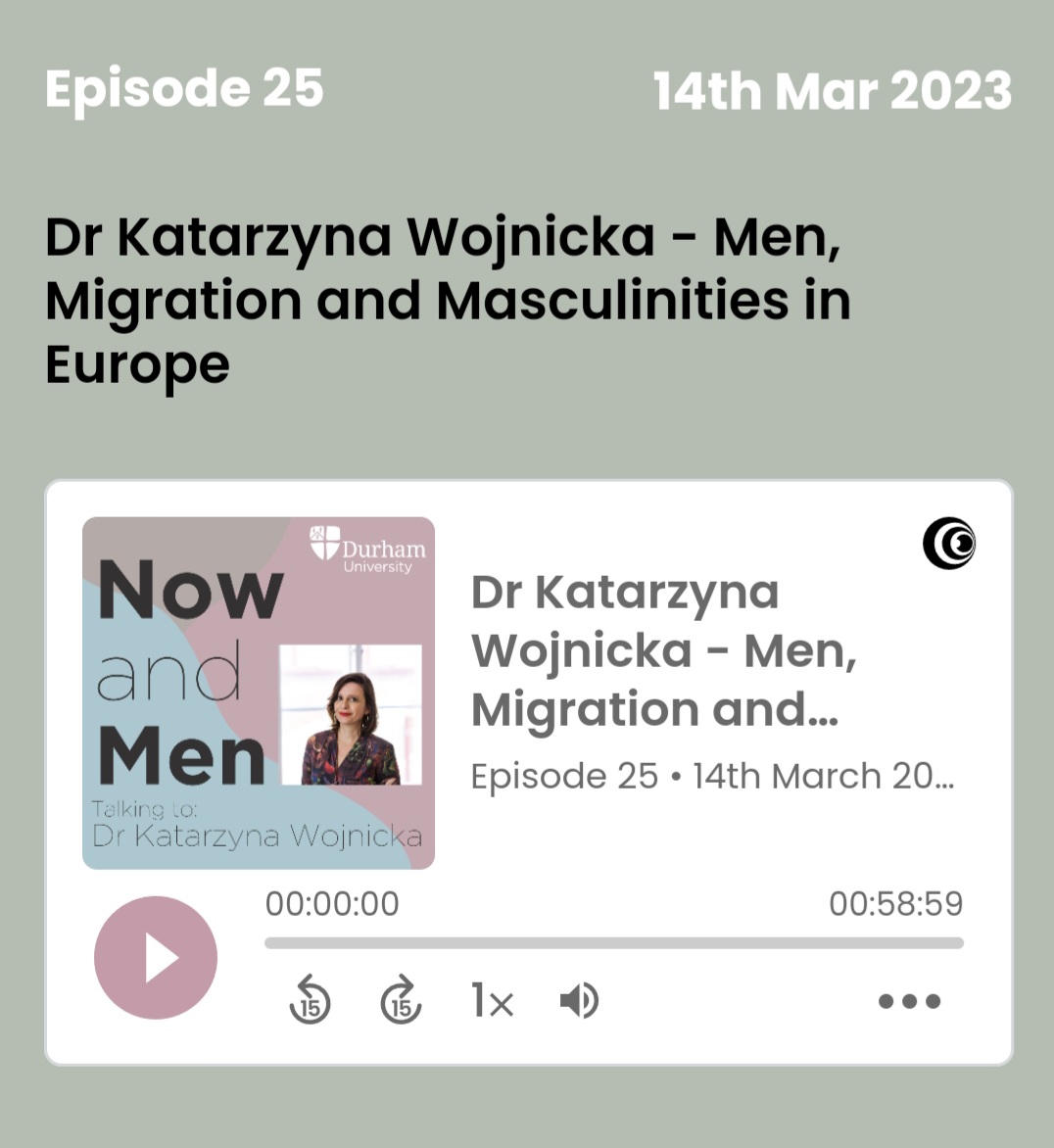
Additionally, in 2022, the Swedish Research Council decided to support our project again (THANKS!) and this time in the form of a Research Communication Grant. This grant allows us to start communicating the findings from our project, not only in scientific papers as initially planned but also elsewhere. We will be publishing not only blog posts and podcast series, but we will also prepare a science theater play that will be staged in Gothenburg in Spring 2024. So stay tuned for even more! And to make your wait more pleasant, I present the first podcast episode where I discuss the results of this fantastic project. Enjoy:
Dr. Katarzyna Wojnicka – Men, Migration, and Masculinities in Europe
 Dr. K & THE men